yoga retreats in the sahara desert

Yoga Retreats in the Sahara desert

The Sahara does something to the nervous system that no other landscape manages quite as completely. The silence is not merely the absence of noise — it is a presence, a quality of stillness that becomes almost physical. The horizon extends beyond what the eye can comfortably measure. The sky at night contains more stars than most people have ever seen, the Milky Way bright enough to cast a faint shadow. And the rhythm that emerges after a day or two in the desert — slower, quieter, more attentive — is the rhythm that yoga practice has been trying to reach all along.


Morocco’s Sahara is one of the most accessible entry points to the great desert on earth. The ergs — the towering seas of sand — begin a few hours south of Marrakech, and the infrastructure for retreats, camps, and desert experiences has developed significantly over the last decade. This is not wilderness survival. It is one of the most quietly transformative environments in which to practice.

AUTHOR

Om Away

DATE PUBLISHED

January 17, 2026

CATEGORY

Share This Article

The Two Great Ergs: Where to Go

The Moroccan Sahara has two main erg (sand sea) areas, each with a distinct character and different retreat infrastructure.

Erg Chebbi and Merzouga — The classic Sahara On the eastern edge of Morocco near the Algerian border, Erg Chebbi is the most dramatic and most visited of Morocco’s dune fields — a sea of orange and gold dunes rising to 150 metres, surrounded by a flat stone hammada plain that makes the dunes appear suddenly and impossibly. The town of Merzouga sits at the edge of the erg, and the camps and retreat centres are ranged along the dune edge. This is where most yoga retreats are based: logistics are easier (six to seven hours from Marrakech by road, or an overnight train to Erfoud then taxi), camps are plentiful and vary from basic to genuinely luxurious, and the dune landscape is spectacular. Merzouga is also the base for excursions to the Tafilalt oasis, the ancient city of Rissani, and the black dunes of Khamlia village.

Erg Chigaga and M’Hamid — The remote Sahara In the far south near the town of M’Hamid el Ghizlane, Erg Chigaga is wilder, emptier, and significantly less visited than Erg Chebbi. Reaching it requires a 4×4 across fifty kilometres of piste (unpaved desert track) — which means fewer camps, fewer visitors, and a more genuinely nomadic quality of experience. Retreat programmes here tend toward smaller groups and more immersive formats. The dunes are less dramatic than Erg Chebbi but the silence is deeper and the sense of genuine remoteness more complete. For those wanting the Sahara without any trace of tourism infrastructure, this is the better choice.

Which to choose? Erg Chebbi if you want accessibility, reliable logistics, and the most dramatic dune landscape. Erg Chigaga if you want genuine remoteness and are willing to work harder to get there. Both offer extraordinary yoga and meditation environments — the difference is primarily in degree of isolation and ease of access.

For context on how the desert fits into Morocco’s broader retreat landscape, our Morocco yoga retreats guide covers all the country’s destinations in one place.

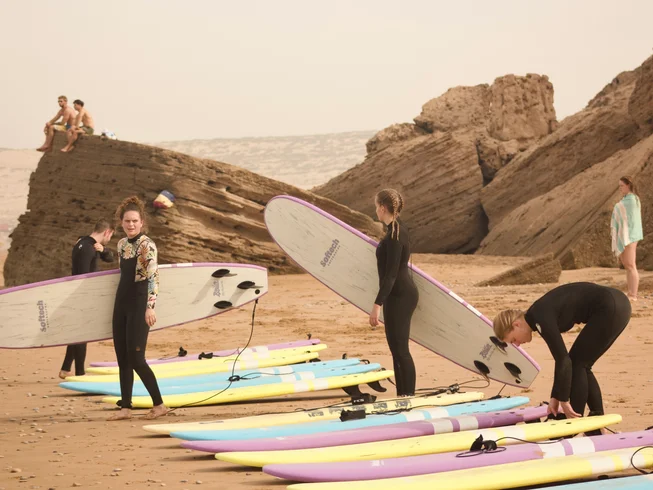
7 Day Surf and Yoga Package with Personalized Beginner Surf Coaching in Taghazout, Morocco

mindfulness nature

6 Day ‘Body & Mind Awareness’ Yoga Holiday in the Atlas Mountains, Morocco

mindfulness nature

4 Day Yoga Retreat in Marrakech Oasis, Morocco

8-Day All-Inclusive Horse Riding Holiday With Yoga and Stretching in Oceanfront Riad, Agadir Morocco

mindfulness nature

10 Day Unforgettable Luxury Yoga Trip, Culture and Nature Adventure in South of Morocco

9 Day Sahara Soul Journey Luxury Yoga Retreat with Cultural Tours in Morocco

What Yoga in the Desert Actually Looks Like

Desert retreat programmes follow the natural rhythm of the desert day — which is entirely determined by temperature.


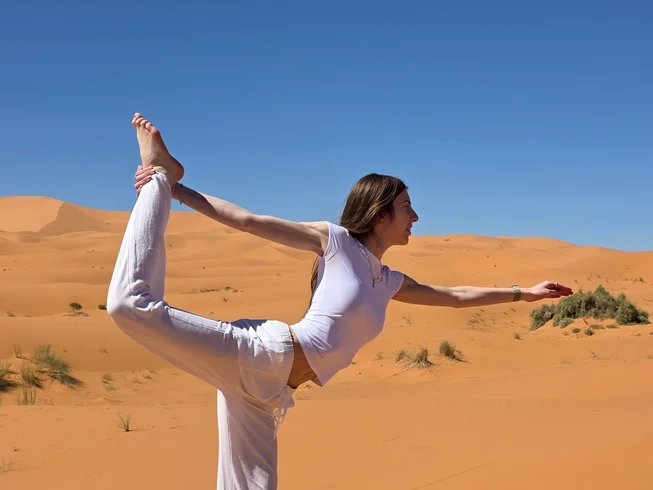
Sunrise practice is the centrepiece of every desert retreat. At first light, when the dunes are still cool and the sky shifts through extraordinary gradients of colour, a yoga session on the sand — or on the flat hammada surrounding the dunes — has a quality that no studio can replicate. The combination of soft light, cool air, absolute silence, and the vast landscape as backdrop creates conditions for practice that practitioners consistently describe as among the most powerful of their lives.


Midday belongs to rest and shade. Desert heat between roughly 11am and 4pm from April through October is serious — temperatures regularly exceed 40°C in summer, and even in spring and autumn the sun is intense. Luxury camps provide shaded relaxation areas, spa treatments, hammam, and cool spaces for reading or sleeping. Basic camps offer tents and shade structures. This enforced rest is part of the practice — the desert teaches that stopping is not failure.


Late afternoon practice as temperatures drop toward sunset is the second yoga session — often yin or restorative, suited to bodies that have spent the day in the heat. The quality of light in the hour before sunset on the dunes is extraordinary: the sand turns deep orange, the shadows lengthen dramatically, and the silence, if anything, deepens.


Evening and night are for stargazing, fire, Gnawa music, and the particular quality of desert darkness. Without light pollution, the Milky Way is visible from horizon to horizon. Many retreat programmes include a stargazing session with a guide who knows the constellations and can point out planets, galaxies, and the particular brilliance of the desert sky.

 
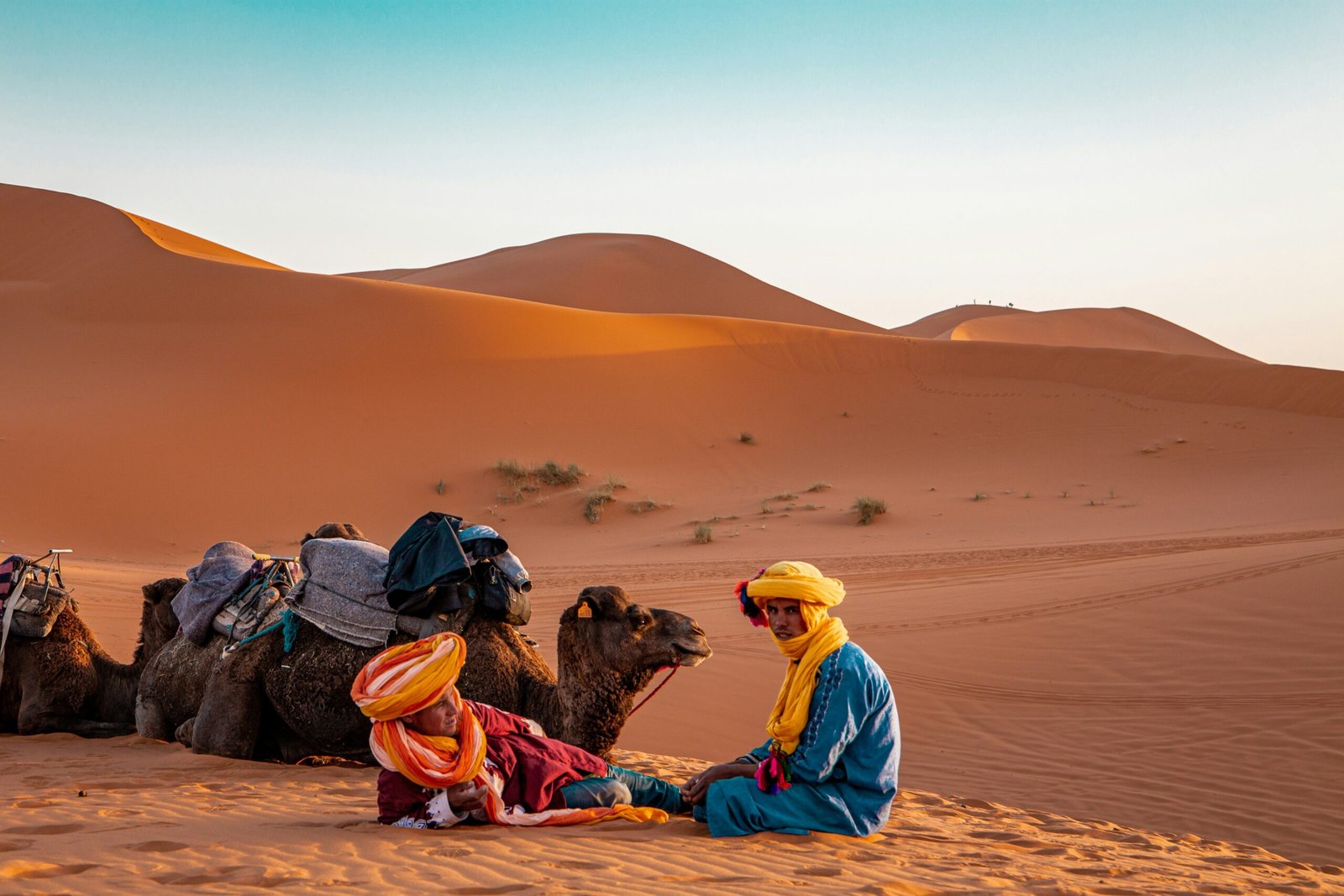
nomads in the sahara desert in morocco

Desert Camps & Accommodation

Desert accommodation is its own category and varies more widely than any other Morocco retreat setting.


Luxury desert camps offer private tents (or permanent structures designed to look like tents) with proper beds, private bathrooms, electricity, air conditioning or cooling systems, and food that would be impressive in any restaurant. Hammam facilities, spa treatments, and curated yoga programmes with visiting teachers are standard. Camps in this category offer genuine comfort in an extreme environment — the wilderness is right outside, but you are not suffering it. Prices are significantly higher than basic camps but comparable to boutique hotel rates in Marrakech.


Mid-range camps have private or semi-private tents with good mattresses, shared bathrooms (hot water usually available), simple but well-prepared meals, and organised activities. The yoga studio may be an open-sided tent or a cleared sand area — both work. This is the most common category and the one where most retreat programmes operate.


Basic Berber camps are for those who want the most authentic experience — sleeping on thin mattresses in traditional tents, minimal electricity, shared facilities, and food cooked on open fires. No spa, no yoga infrastructure beyond what you bring yourself. The trade-off is complete simplicity and a genuinely nomadic quality of life for a few days. Recommended for adventurous travellers who prioritise experience over comfort.


What all camps share: the stars are the same from every tent. The silence is the same. The sunrise is the same. The choice of camp affects your comfort during the day — it does not affect the quality of the desert itself.

What to Eat in the Desert

Desert camp food is simple, necessarily — you are a long way from any market. But Moroccan desert hospitality means that simplicity does not mean poor quality.

Tagine dominates camp menus — slow-cooked lamb or chicken in clay pots over charcoal, fragrant with cumin, coriander, and preserved lemon. Made properly over several hours, it is exactly the right food for a desert evening: warming, filling, and deeply satisfying after a day in the heat and sand.

Couscous appears on Fridays and at longer retreats — steamed semolina with vegetables and meat, served with rich broth and harissa on the side. In the desert, eating couscous in the traditional manner (with your right hand, rolled into small balls) in the company of local guides feels like participation in something ancient and genuine.

Mechoui — whole slow-roasted lamb cooked in a pit in the sand — appears at special occasions and longer retreats. The cooking process (the lamb is lowered into a clay-lined pit with hot coals, sealed, and left for several hours) produces meat of extraordinary tenderness. When a camp offers mechoui, it is the meal of the stay.

Dates are the food of the desert — the Tafilalt oasis near Merzouga is one of Morocco’s great date-producing regions, growing varieties (Medjool, Boufeggous, Aziza Brahim) with complex sweetness very different from the dates sold in European supermarkets. Arriving at a camp to be welcomed with dates and mint tea is an old desert tradition that makes immediate sense in a landscape where sweetness and warmth are both precious.

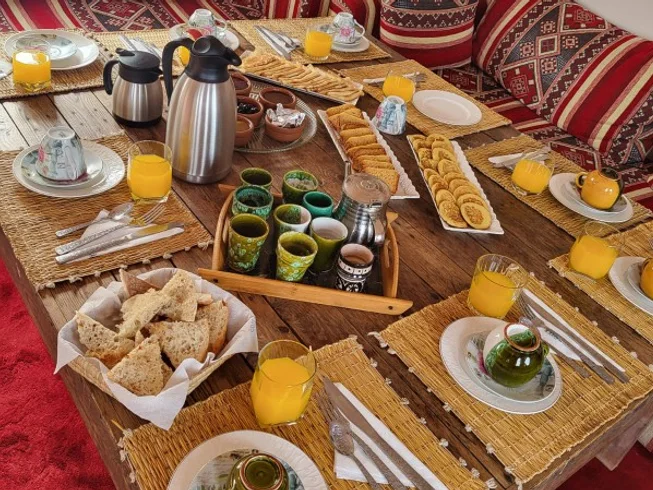
Mint tea is served constantly — before meals, after meals, during rest time, whenever conversation begins. In the desert, where water management is fundamental to daily life, the ritual of tea preparation and sharing carries particular weight. Three glasses minimum. Never refused.

Harira appears at breakfast and as a starter at dinner — thick, warming, complex, and restorative in a climate where the temperature swing between day and night can be dramatic.

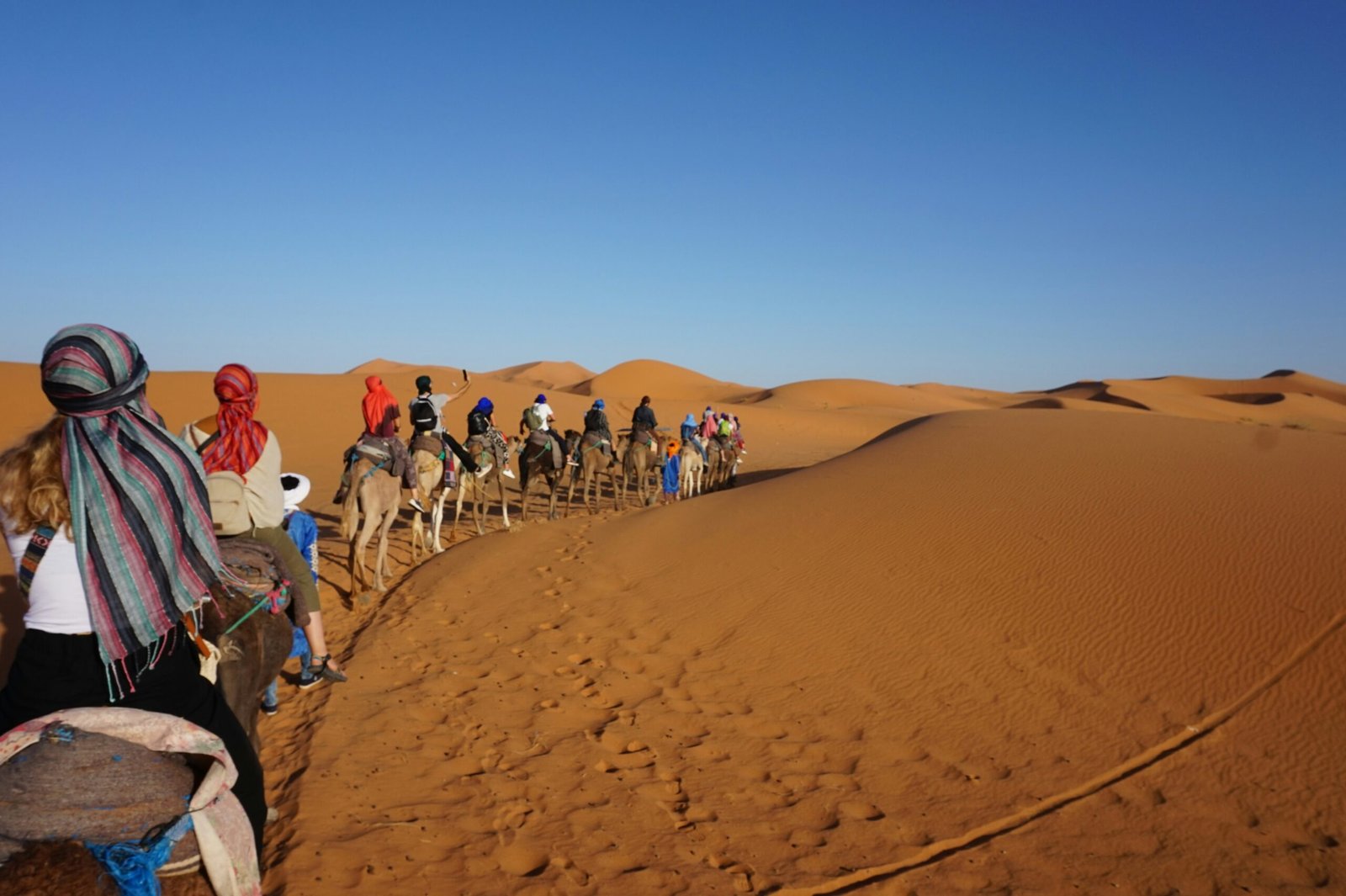
nomads i the sahara desert in a caravan
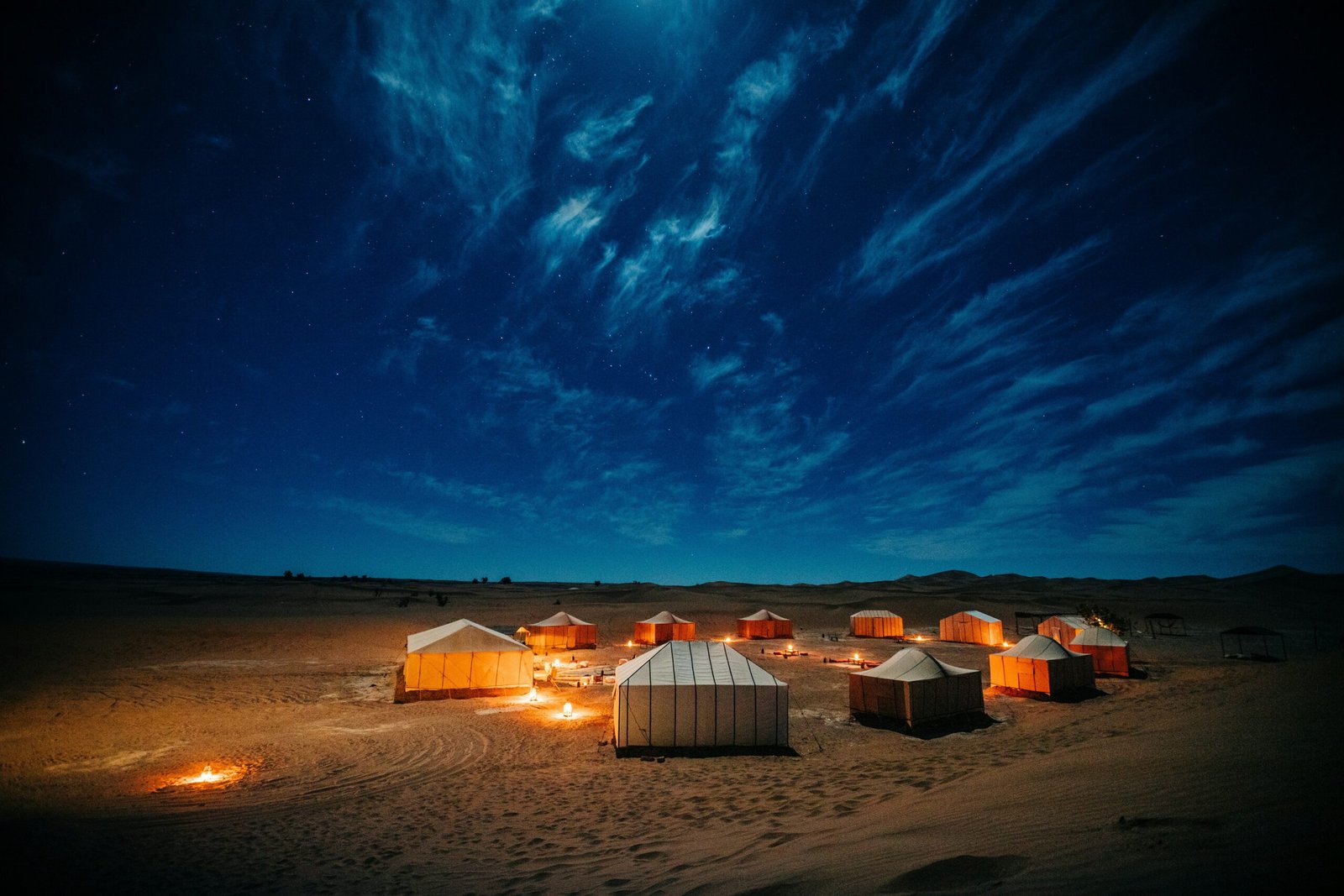
starred night in the sahara desert

Beyond Yoga: What to Do in the Sahara

Camel trekking The classic Sahara experience — riding into the dunes at sunset, arriving at a remote camp as the light fails, eating dinner around a fire, sleeping under stars. In the morning, the return journey at dawn with the dunes at their most photogenic. Even if you approach it sceptically, the combination of slow animal pace, vast landscape, and the specific discomfort of a camel saddle creates an experience that is hard to forget. Most retreat programmes include at least one camel excursion.


4×4 excursions into the desert For reaching the further dunes, the fossil beds of the hammada, and the more remote areas beyond walking distance, 4×4 vehicles are the tool. Experienced local drivers who know the desert intimately take small groups to landscapes that see almost no visitors — black volcanic hammada, ancient fossil beds, dried river valleys that come alive for a few days when rain falls. These excursions ground the retreat in the actual geography of the desert rather than the immediate environs of the camp.


Stargazing The Moroccan Sahara has almost no light pollution. On a clear night — which is almost every night — the sky contains so many stars that the familiar constellations are initially difficult to find because they are surrounded by thousands of others. The Milky Way is a physical presence, a band of light across the full arc of the sky. A guided stargazing session with someone who can explain what you are seeing turns an extraordinary spectacle into a genuine education.


Khamlia village and Gnawa music A few kilometres from Merzouga, the small village of Khamlia is home to a community descended from West African slaves brought to Morocco centuries ago, who maintain the Gnawa musical tradition — deep bass guembri lute, qraqeb metal castanets, and trance-inducing call-and-response vocals. An evening in Khamlia listening to Gnawa music in someone’s home is one of the most culturally specific and genuinely moving experiences available in Morocco. Ask your camp or retreat organiser to arrange it.


Fossil hunting in the hammada The black hammada plain surrounding Erg Chebbi sits on one of the world’s richest Devonian fossil deposits — the same geology that produces the trilobites, orthoceras, and ammonites sold throughout Morocco. Guided walks with local guides who know the geological zones turn up genuine specimens embedded in the rock, context that transforms the fossils sold in every Moroccan market from tourist trinkets into chapters of a 400-million-year-old story.


Rissani market and the Tafilalt oasis Twenty kilometres from Merzouga, Rissani is the market town for the Tafilalt oasis — Morocco’s largest date-palm oasis, historically one of the most important commercial centres in the Sahara. The weekly market (Tuesday, Thursday, Sunday) brings together nomadic Berbers, date farmers, spice traders, and livestock sellers in a scene that functions as it has for centuries. Buy dates, photograph nothing without asking, drink tea with traders, and understand that the Sahara has always been a place of commerce and movement as much as emptiness and silence.

Best Time for a Yoga Retreat in the Sahara

October and November are the best months — warm days (25–30°C), cool evenings, the summer heat broken, and the desert at its most accessible and most beautiful. November in particular sees fewer visitors and the most atmospheric conditions. For our full guide to what Morocco offers in autumn, see yoga retreats in Morocco in November.


March to May rivals autumn — spring in the desert brings warm days, manageable temperatures, and the particular quality of light that the low spring sun creates on the dunes. April is excellent.


December to February is cold — desert nights in winter can drop to near freezing, and the days are short. Luxury camps with heating are comfortable; basic camps require serious warm clothing. The advantage is absolute solitude and the drama of a cold, clear desert winter sky.


June to September is hot — July and August can see temperatures above 45°C, which makes outdoor yoga impractical except at the very edges of the day. Summer desert retreats exist for those who are specifically drawn to heat as a purification practice, but they are not recommended as a first experience.

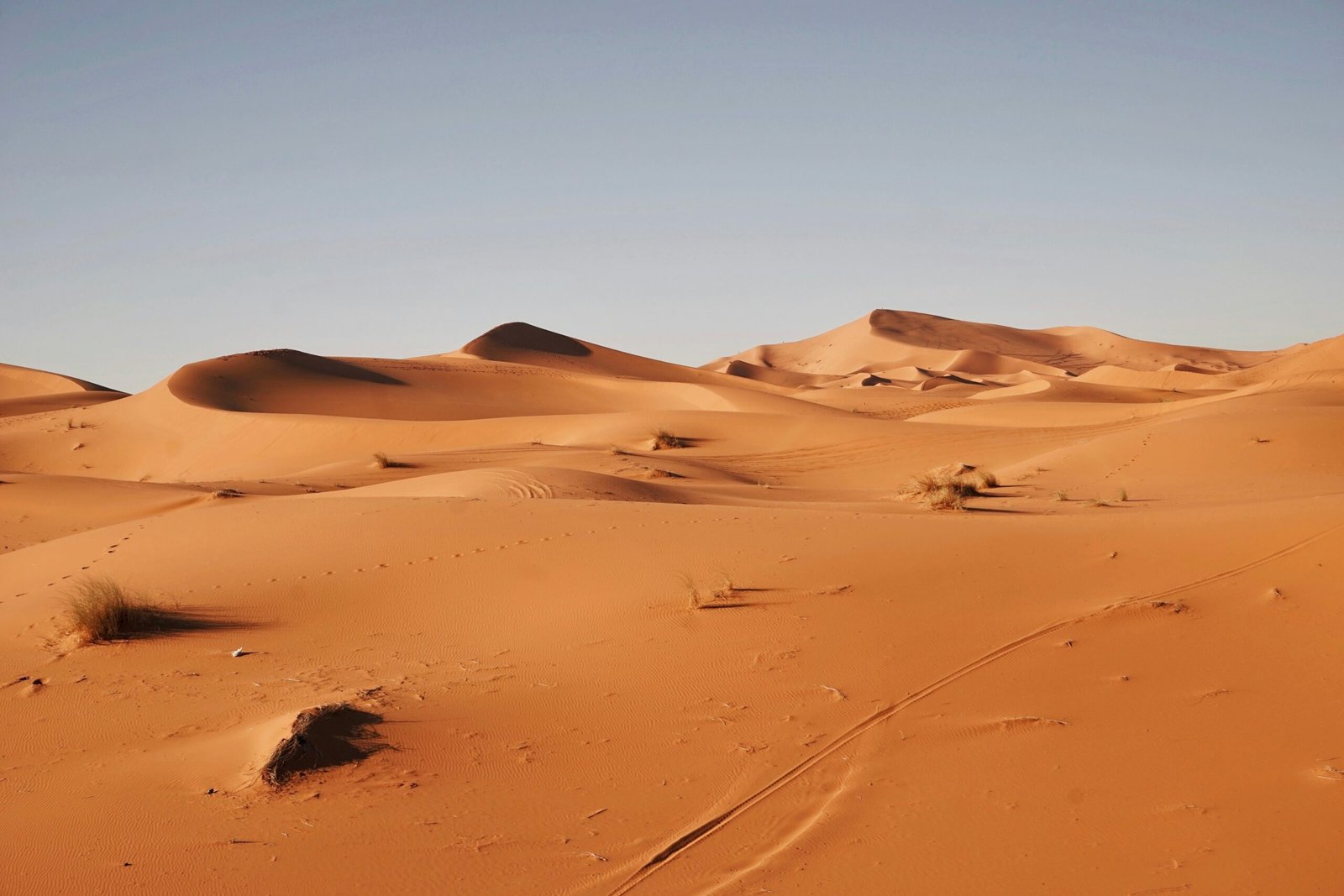
yoga retreats in the sahara desert

Getting to the Sahara

From Marrakech: The standard route is a six to seven hour drive south through the High Atlas (via the Tizi n’Tichka pass, 2,260m) to Ouarzazate, then east through the Drâa Valley and Zagora to Merzouga. The drive is extraordinary — the road passes through the full transition from Mediterranean to desert, and many retreat programmes treat it as part of the experience, stopping at the Kasbah Ait Benhaddou and the Drâa Valley palmeraies en route.


Overnight train from Casablanca: The train to Erfoud (the nearest city to Merzouga) leaves Casablanca in the evening and arrives the following morning — a useful option for those flying into Casablanca rather than Marrakech. Erfoud to Merzouga is 53km by taxi.


Organised transfers: Most desert retreat programmes include transfers from Marrakech, either by shared minibus or private vehicle. This is the simplest option and removes all the coordination overhead of independent travel to a remote location. Worth confirming what is included when booking.

If you are combining a desert retreat with time in Marrakech, the standard approach is to spend two to three days in the city before or after the desert portion — the contrast between the medina’s intensity and the desert’s silence is part of what makes both experiences more vivid.

faqs: yoga retreats in the sahara desert

1. When is the best time for a yoga retreat in the Sahara?
Spring (March–May) and autumn (September–November) are ideal. Daytime: 22–30°C (72–86°F) — warm enough for outdoor yoga, not too hot. Nights: 10–15°C (50–59°F) — cool but comfortable with proper bedding. Winter (December–February) offers mild days (15–22°C / 59–72°F) but very cold nights (0–8°C / 32–46°F) — magical for stargazing but bring thermal layers and a good sleeping bag. Summer (June–August) is extremely hot (35–45°C+ / 95–113°F+) — only recommended if the retreat has air-conditioned indoor spaces and schedules outdoor practice at sunrise (5–6 AM) and sunset (7–8 PM). Many camps close in July and August.


2. How do I get to a Sahara yoga retreat?
Most Sahara retreats are based near Merzouga (Erg Chebbi dunes), approximately 8–9 hours by road from Marrakech (550 km / 340 miles). Options: (1) Retreat transfer — most organize shared minibuses for €50–100 each way, often including stops at Aït Benhaddou, Dades Valley, or Todra Gorge. (2) Private driver — €200–350 each way, more comfortable and flexible. (3) Fly to Errachidia (ERH) from Marrakech (1.5 hours, around €100–150 round trip), then a 2-hour drive to Merzouga — retreats can arrange pickup. (4) Rent a car — possible but roads are long, and desert driving requires experience. For Erg Chigaga (more remote), allow an extra 2–3 hours of off-road driving. Always arrange pickup in advance — there is no public transport to the dunes.


3. Is the Sahara safe for a solo traveler on a yoga retreat?
Yes — with a reputable retreat operator. The desert is sparsely populated and local Berber communities are welcoming and accustomed to tourists. Solo travelers should: choose a retreat that handles all logistics (transfers, guides, meals, camping), avoid traveling alone into the desert without a guide, book through established platforms or well-reviewed retreats, and share your itinerary with someone at home. Most Sahara retreats are small groups (6–15 people), making them social and safe for solo participants. Single rooms are rare in desert camps — expect shared tents (same gender) or pay a supplement for a private tent. The biggest risk is not crime but logistics: dehydration, getting lost, or lack of medical facilities. Your retreat operator will manage all of this.


4. What types of yoga are commonly offered in the Sahara?
Hatha and gentle Vinyasa are most common — slow, breath-focused, suitable for all levels. Yin yoga is very popular in the desert because the stillness and silence naturally support longer, passive holds. Restorative yoga (using bolsters and blankets) works well on sand. Many retreats emphasize Pranayama (breathwork) — the dry, clean desert air is perfect for deep breathing practices. Meditation is central, often held at sunrise or under the stars. Power yoga, Ashtanga, and hot yoga are not suitable — the desert is hot enough, and the vibe is introspective, not athletic. Some retreats offer “sand yoga” (directly on the dunes) — bring a thick mat or blanket.


5. Can I combine yoga with a camel trek or desert camping?
Yes — this is the classic Sahara experience. Most retreats include: a 1–2 hour camel trek to a deeper dune camp, one night camping under the stars (or in basic tents), sunrise yoga on a remote dune, and a camel ride back. Some luxury retreats offer 2–4 day trekking experiences , walking or camel-trekking between camps, with yoga at each stop. Camel treks are gentle (camels walk slowly) and suitable for beginners, but be prepared for a bumpy, swaying ride — some people find it uncomfortable on hips and lower back. Always ask if the trek is optional; many retreats offer a 4×4 transfer as an alternative for those who prefer not to ride camels.


6. What can I eat at a yoga retreat in the Sahara?
Simple, hearty, vegetarian-friendly Berber cuisine. Expect: vegetable tagines (potatoes, carrots, zucchini, sweet potatoes, chickpeas, olives, preserved lemons), lentil or bean soupscouscous with seven vegetables (Friday specialty), Berber omelette (eggs with tomatoes, onions, spices), fresh bread (baked daily in sand-covered ovens), mint tea (served throughout the day — the “Berber whiskey”), seasonal fruit (oranges, dates, pomegranates in autumn), and sometimes Berber pizza (a stuffed flatbread baked in embers). Meat (chicken, lamb, or goat) is available at some camps but usually not included in standard packages — ask if you want it. Vegetarian and vegan options are easy to accommodate — desert cooking is naturally plant-based. Everything is cooked slowly over fire or gas. No alcohol in traditional camps (some luxury camps may offer wine or beer — ask ahead). Water is provided (bottled or filtered) — stay hydrated in the dry air.


7. Is the Sahara good for a silent or meditation retreat?
Yes — the Sahara is arguably the best place on earth for silence. There is no traffic, no wind (at night), no call to prayer (no mosques in the deep desert), no airplane noise, no insects (too dry). Just absolute stillness. Many retreats offer dedicated silent retreats (3–7 days) with noble silence, no eye contact, no phones, no reading — just sitting, walking, and breathing. Even non-silent retreats are naturally quiet. The stars at night are unparalleled (no light pollution for hundreds of kilometers) — many retreats include guided stargazing or astronomy sessions. For the deepest silence, choose Erg Chigaga over Erg Chebbi — Chigaga is more remote, harder to reach, and has fewer tourists. Winter (November–February) is the quietest season (fewer visitors). The only “noise” is your own mind — which is exactly why people come to the desert.

Share Your Thoughts

Your email address will not be published. Required fields are marked *

Leave a Reply

Your email address will not be published. Required fields are marked *